Governance, Ethics & Trust
Board Governance
Independence of Management Structure
Independence is a fundamental element of Good Corporate Governance, particularly in carrying out the oversight function. As an entity committed to service integrity, IDSurvey implements a two-tier governance system in which the independence of the Board of Commissioners is ensured through the presence of an Independent Commissioner. With a composition of 1 (one) out of 4 (four) members of the Board of Commissioners holding Independent Commissioner status, IDSurvey has fulfilled the provisions of OJK Regulation No. 42/POJK.04/2020 concerning Affiliated Transactions and Conflict of Interest Transactions.
Stringent governance principles continue to be upheld to mitigate the risk of conflicts of interest and any potential negative implications that may arise. IDSurvey ensures that every oversight decision is made objectively and free from the influence of interested (non-executive) parties. The presence of Independent Commissioners with expertise backgrounds in academia, law, and the public sector further strengthens the checks and balances mechanism. This ensures that the interests of all shareholders, particularly minority shareholders, are consistently and effectively protected in a professional manner.
In support of achieving the Company's long-term value, the Board of Commissioners of IDSurvey, as the overseer of corporate governance, has fulfilled the independence criteria as required: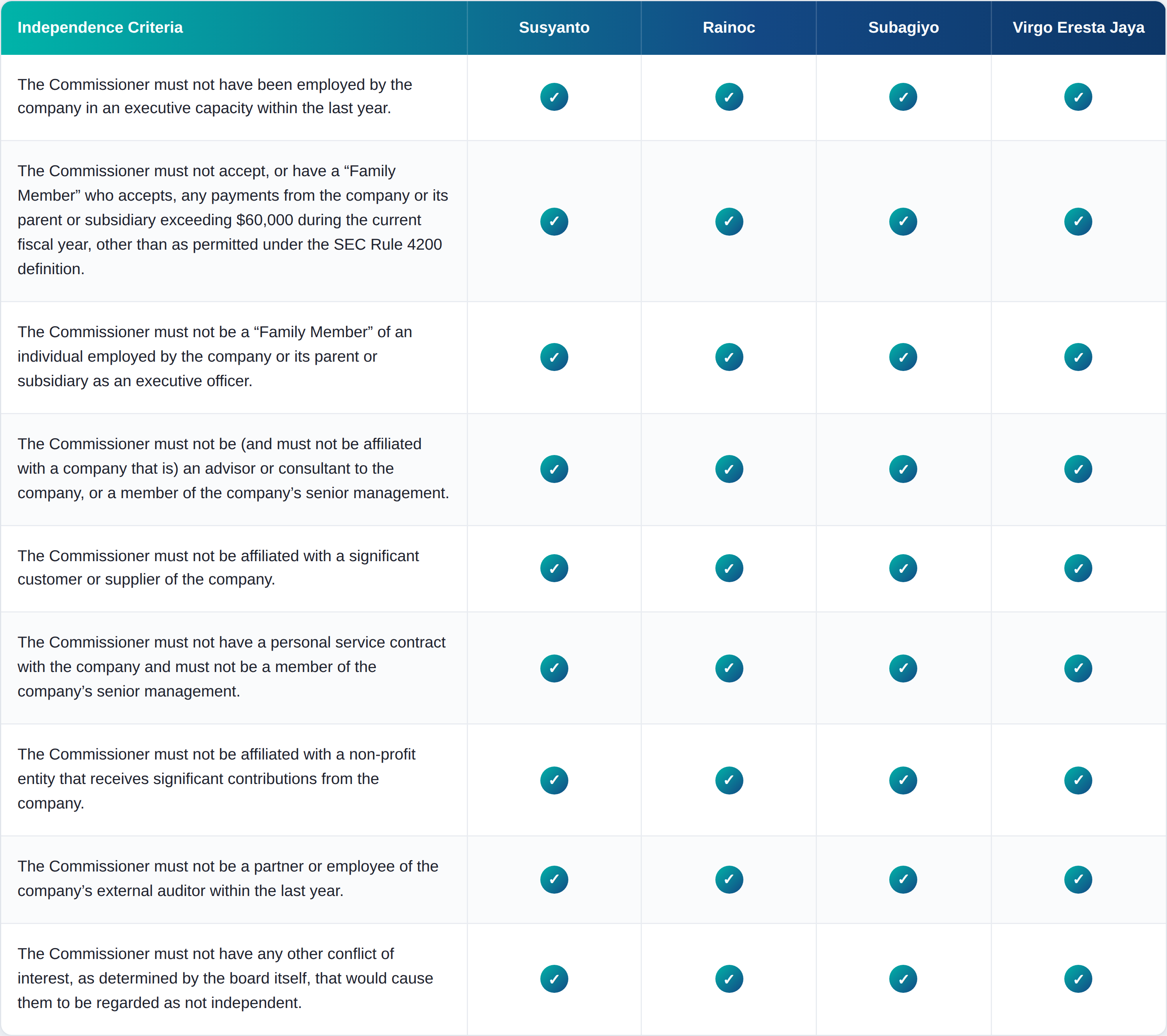
Meeting Frequency and Attendance Rate of the Board of Commissioners in the 2025 Meeting Agenda
The Board of Commissioners regularly convenes internal meetings and joint meetings with the Board of Directors. Internal meetings are held at least once a month or as needed, while joint meetings are conducted monthly to evaluate and discuss the Company's performance.
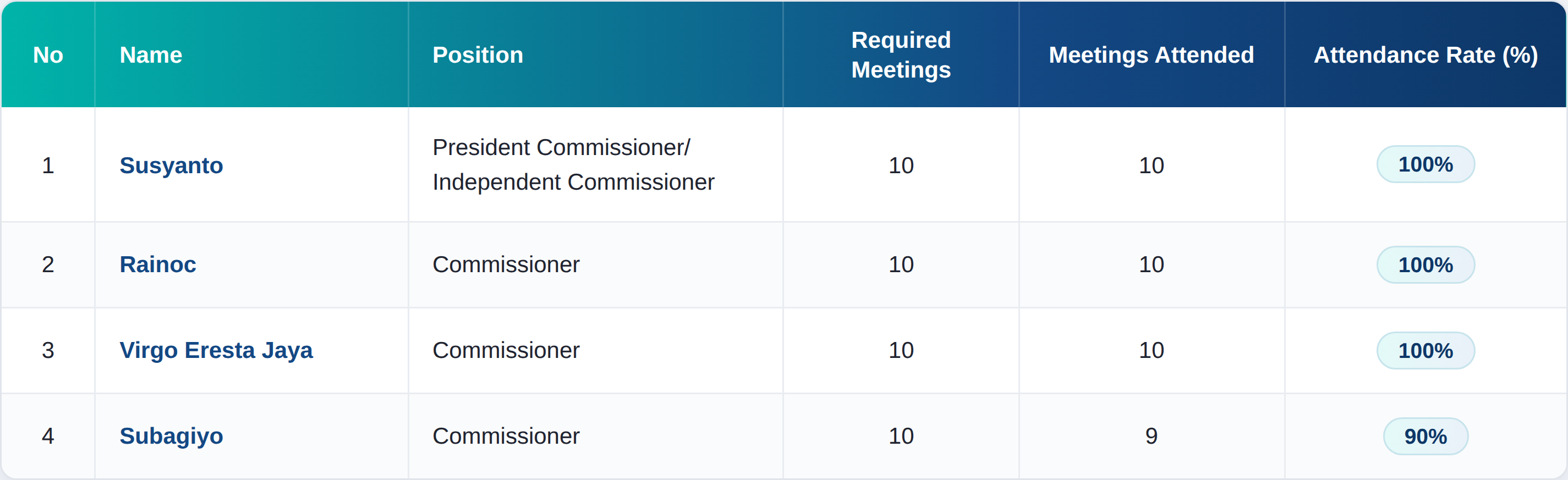
Attendance Of The Board Of Commissioners & Board Of Directors In Joint Meetings, January - December 2025
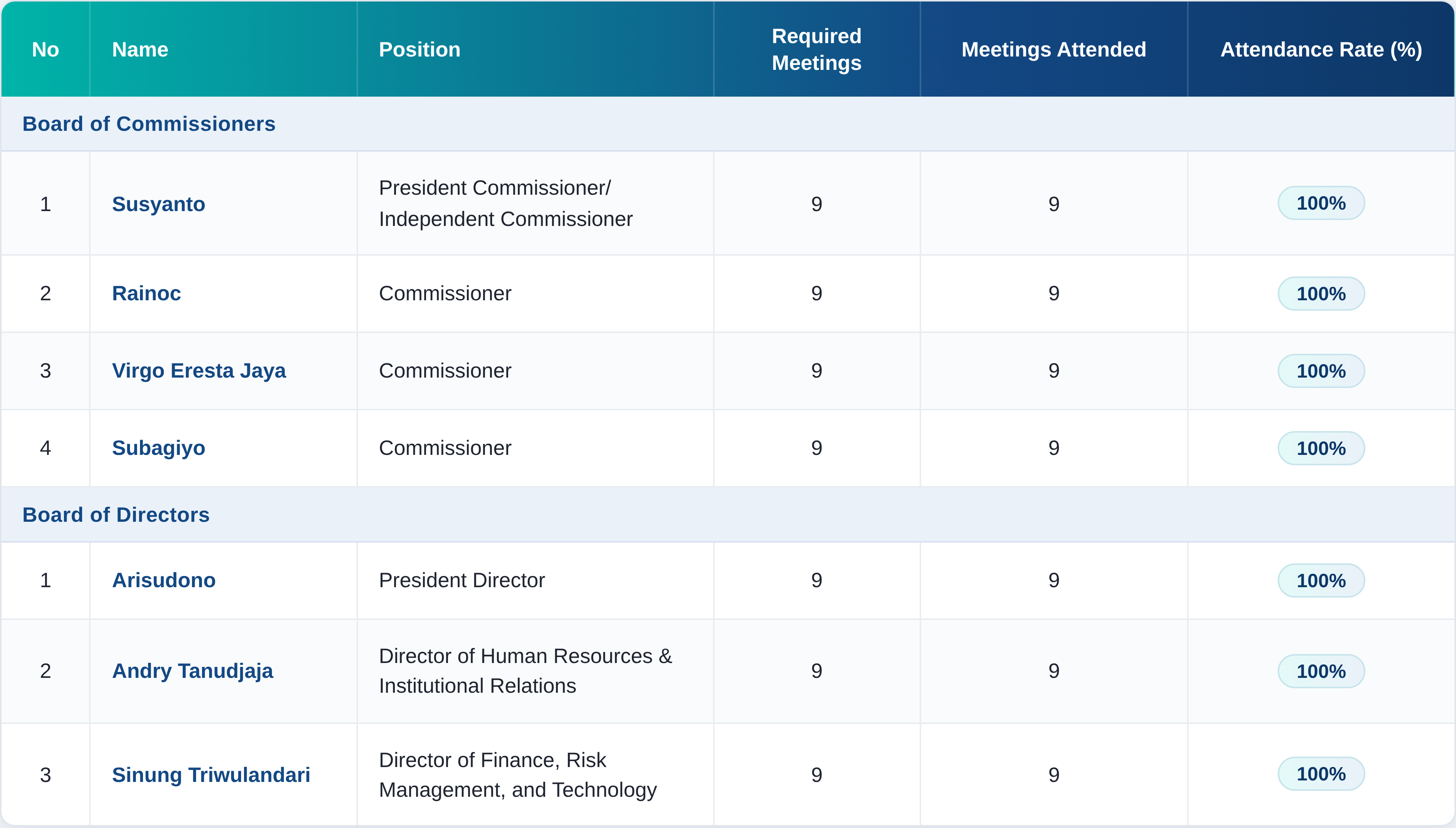
Throughout 2025, the meeting agendas conducted by the Board of Commissioners of IDSurvey were as follows: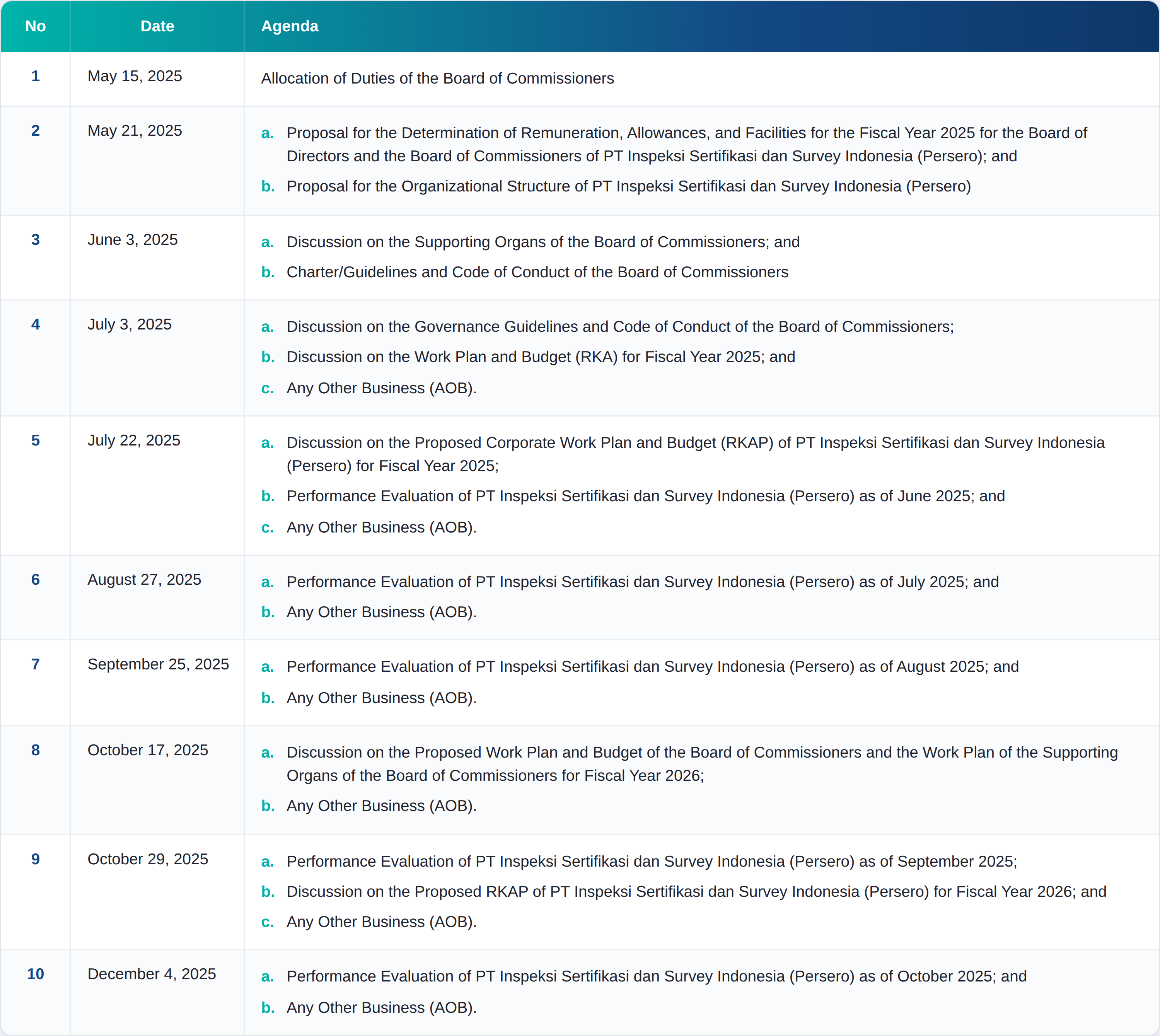
Meeting Frequency and Attendance Rate of the Board of Directors in the 2025 Meeting Agenda
Throughout 2025, the Board of Directors held 26 routine internal meetings. Daily coordination among directors and their respective teams continued to take place flexibly according to operational needs. Meeting procedures, including conduct, minute-taking, follow up evaluation of previous decisions, and discussion of directives from the Board of Commissioners, have been formally regulated in the articles of Association and the Board Manual.
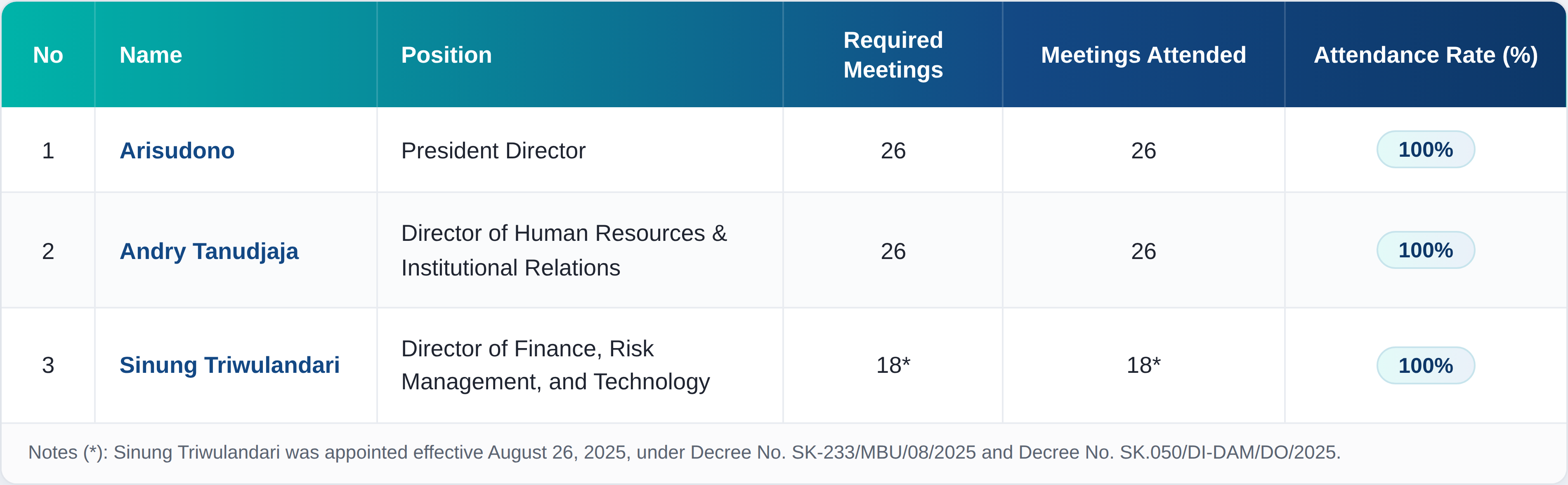
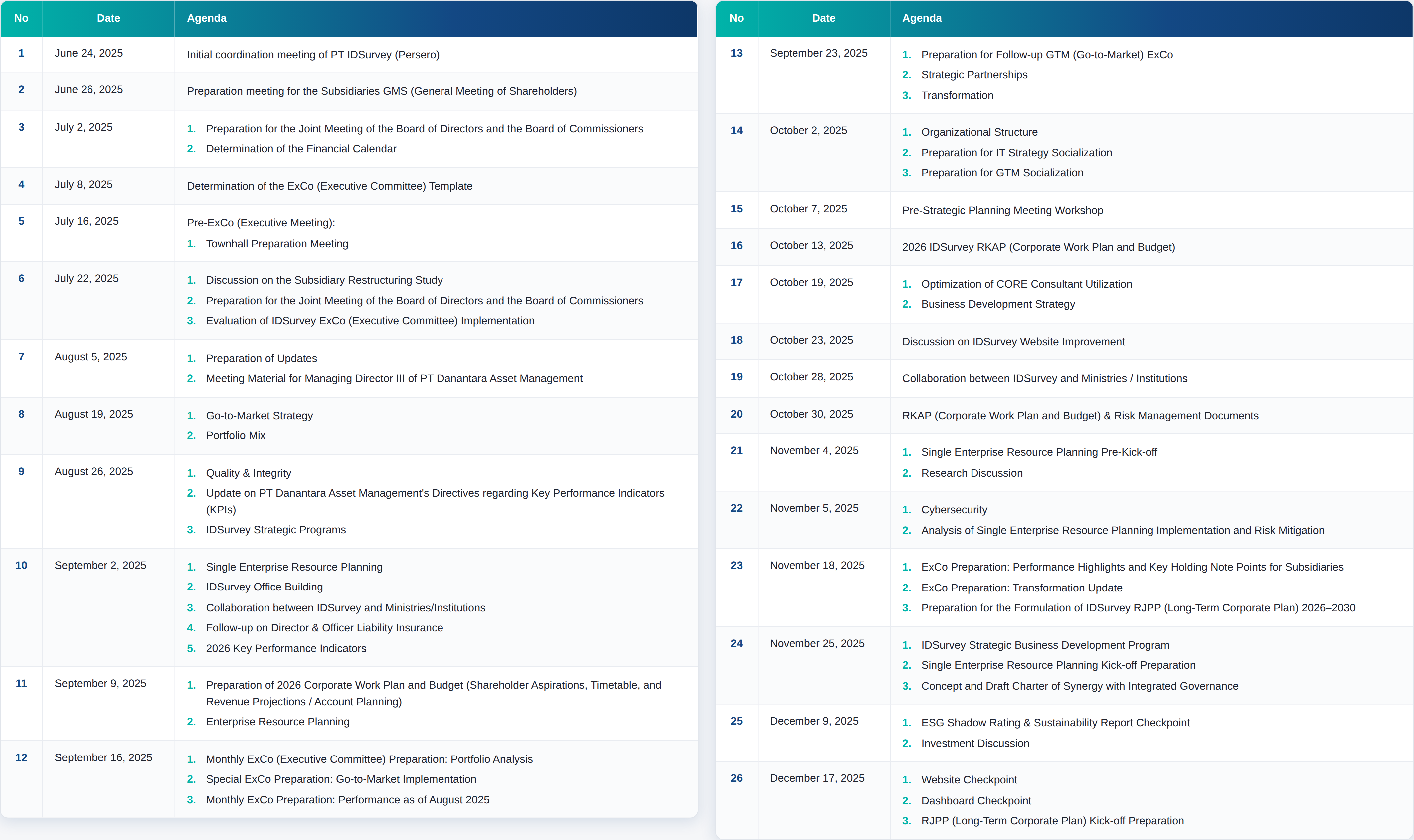
Throughout 2025, the meeting agendas conducted by the Board of Directors of IDSurvey were as follows:
Board of Director Succession Mechanism
The Company has a succession mechanism for the Board of Directors, carried out under the supervision of the Board of Commissioners through its nomination function, with the support of the Shareholders. Each year, the Board of Commissioners evaluates the implementation of this development and succession plan. This process is supported by the Nomination and Remuneration Committee, which regularly reviews the Company’s talent management system, validates and calibrates selected candidates, and prepares development plans for members of the Board of Directors. The results of this process are then taken into consideration by the Shareholders in determining the composition of the Board of Directors at the General Meeting of Shareholders (GMS), thereby ensuring the continuity of the Company’s leadership.
Members of the Board of Commissioners and the Board of Directors are appointed through the General Meeting of Shareholders (GMS) for a five-year term of office and may be reappointed for one subsequent term. Nevertheless, the GMS retains the authority to dismiss board members at any time. Accordingly, the appointment of board members follows a five-year term cycle rather than an annual election. This provision is set out in the Company's Board Manual, based on Minister of SOEs Regulation No. PER-3/MBU/03/2023 concerning Organs and Human Resources of State-Owned Enterprises.
Duties and Responsibilities of the Board of Commissioners and the Board of Directors
The division of duties, responsibilities, and authorities of the Board of Commissioners and the Board of Directors refers to the Company’s Articles of Association as set out in the Deed of Statement of Resolutions of the Shareholders of PT Inspeksi Sertifikasi dan Survey Indonesia (Persero) Number 01 dated February 3, 2026. These provisions are further elaborated in the Company’s Board Manual. The Company applies a two-tier board system. Under this system, the Board of Commissioners performs the functions of supervision and advisory, while the Board of Directors performs the function of managing the Company. Both organs work independently in accordance with their respective authorities, with the shared objective of safeguarding the Company’s long-term business continuity.
Board of Commissioners
The Board of Commissioners is tasked with supervising the management policies and the management of the Company carried out by the Board of Directors, as well as providing advice to the Board of Directors. This supervision covers the implementation of the Company’s Long-Term Plan (RJPP), the Company’s Work Plan and Budget (RKAP), the provisions of the Articles of Association, GMS resolutions, and prevailing laws and regulations. The main responsibilities of the Board of Commissioners include:
Providing advice to the Board of Directors in carrying out the management of the Company.
Examining, reviewing, and signing the RJPP and RKAP prepared by the Board of Directors, and providing opinions and recommendations to the GMS on these documents.
Following the development of the Company’s activities and promptly reporting to the GMS if there are signs of declining performance.
Examining and reviewing periodic reports and the Annual Report prepared by the Board of Directors, and signing the Annual Report.
Establishing the Audit Committee and other supporting committees, and proposing the Public Accountant to the GMS.
Preparing the annual work program of the Board of Commissioners, which is included in the RKAP.
Reporting the personal and/or family share ownership in the Company and in other companies.
Submitting a report on the implementation of supervisory duties during the financial year to the GMS.
To support these duties, the Board of Commissioners is authorized, among other things, to examine the Company’s books, documents, and assets; request explanations from the Board of Directors and officials below them; temporarily suspend members of the Board of Directors in accordance with the Articles of Association; and engage experts at the Company’s expense when necessary. Each member of the Board of Commissioners must carry out their duties in good faith, with prudence, and with responsibility. They are personally and jointly and severally liable for the Company’s losses if they are at fault or negligent in performing their duties.
Board of Directors
The Board of Directors is tasked with carrying out all actions related to the management of the Company in the interest of the Company and in accordance with its aims and objectives. The Board of Directors also represents the Company inside and outside the court, subject to the limitations stipulated in laws and regulations, the Articles of Association, and GMS resolutions. The main responsibilities of the Board of Directors include:
Striving for and ensuring the implementation of the Company’s business and activities in accordance with its aims, objectives, and business activities.
Preparing the RJPP, the RKAP, and any amendments thereto in a timely manner, for submission to the Board of Commissioners and the Shareholders to obtain GMS approval.
Preparing the Annual Report as a form of accountability for management, as well as the Financial Statements based on Financial Accounting Standards, to be audited by a Public Accountant.
Establishing accounting and internal control systems, particularly for the functions of management, recording, storage, and supervision.
Maintaining and keeping the Register of Shareholders, the Special Register, the minutes of GMS meetings, the minutes of meetings of the Board of Commissioners and the Board of Directors, and other Company documents.
Submitting periodic reports and providing explanations on any matter requested by the Board of Commissioners and the Shareholders.
Preparing and determining the Company’s organizational structure and blueprint.
Establishing aligned policies for Subsidiaries, including in the areas of finance, risk management, human resources, occupational health and safety, environmental management, and social and environmental responsibility.
In carrying out its duties, the Board of Directors is authorized to determine the Company’s management policies, delegate authority to members of the Board of Directors or employees, appoint and dismiss employees as well as the Corporate Secretary, and regulate employment provisions with the approval of the GMS. The Board of Directors must maintain independence, make decisions objectively and free from conflicts of interest, and sign an Integrity Pact as a form of commitment.
In accordance with Law No. 40 of 2007 on Limited Liability Companies (Article 97 and Article 114) and the Board Manual, each member of the Board of Directors and the Board of Commissioners is fully and personally liable for the Company’s losses if proven to be at fault or negligent in performing their duties. Where there are two or more members, such liability applies jointly and severally. A member may be exempted from such liability only if they can prove that they acted in good faith and with prudence, had no conflict of interest, and made efforts to prevent the occurrence of losses (business judgment rule).
Sustainability Strategy and Governance
IDSurvey implements a tiered governance mechanism to ensure that ESG issues are overseen up to the Company's highest level. This structure adopts a two-tier system in line with Indonesia's governance framework, distinguishing between the oversight function (Board of Commissioners) and the management function (Board of Directors), and is supported by coordination forums and technical implementers through the IDSurvey Sustainability Committee, which reports to the Executive Committee and ensures the Company carries out sustainability programs and principles across the environmental, social, and governance aspects.
Executive oversight is carried out through two main forums:
a. Executive Committee. The highest coordination forum, chaired by the President Director of the Holding Company and comprising the Presidents Directors of the Subsidiaries. The Executive Committee sets the strategic direction for sustainability implementation across the IDSurvey Group, ensures sustainability initiatives are integrated with corporate strategy and transformation, grants strategic mandates to the Supervising Directors, and serves as the Group's primary representative in communicating sustainability commitments to external stakeholders at the strategic level.
b. Supervisory Directors. A coordination forum chaired by the Director overseeing the sustainability function and comprising the relevant Directors of the Subsidiaries. The Supervising Directors approve sustainability policies, strategies, roadmaps, and frameworks; oversee and evaluate their implementation at least once (1) per fiscal year; monitor and assess sustainability risks and opportunities; and evaluate the performance of the Chair of the Sustainability Committee through coordination meetings held at least twice (2) per fiscal year.
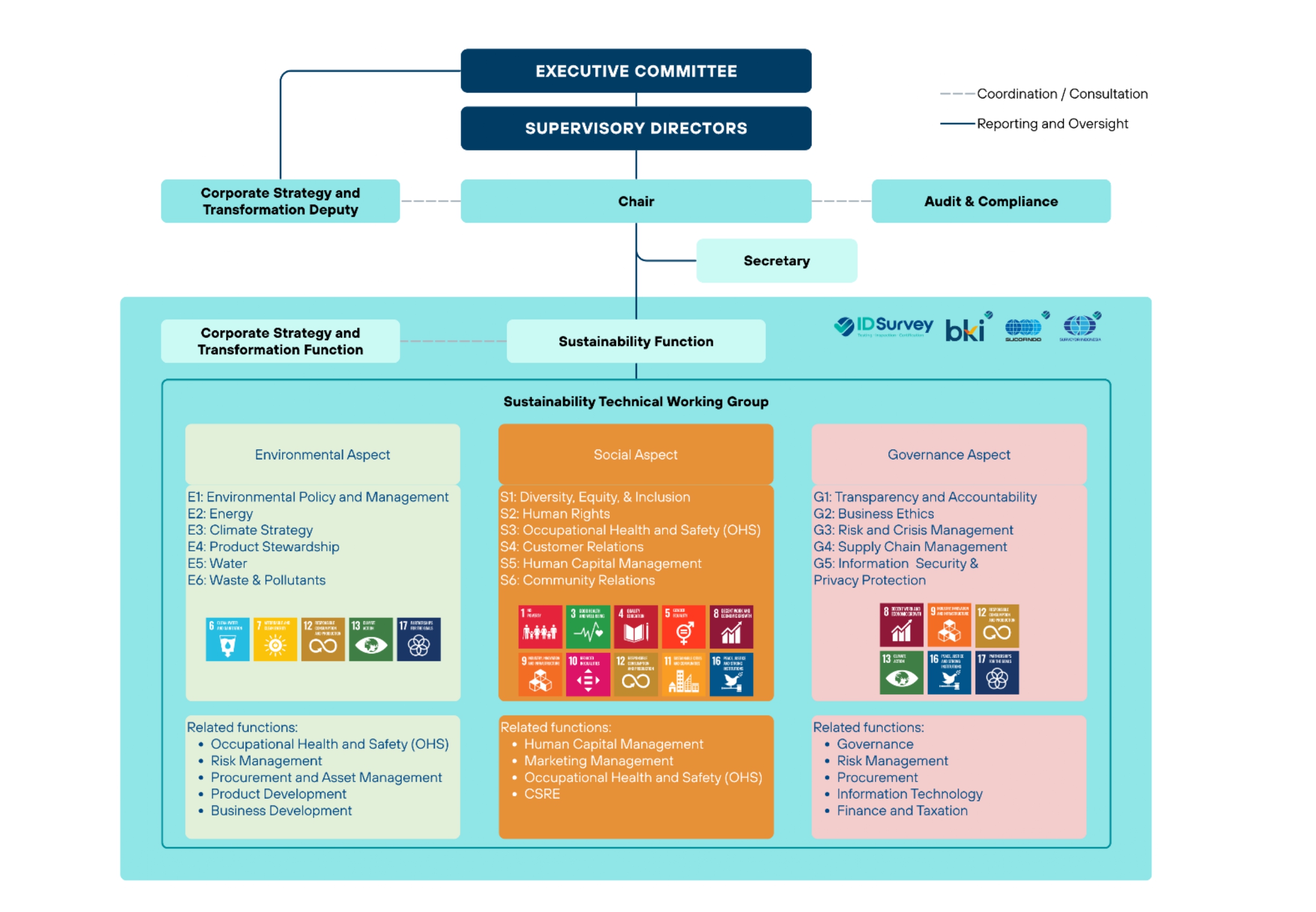
IDSurvey designates roles with specific responsibilities for ESG issues at two levels:
Supervisory Directors (Board of Directors/C-suite level): The Director specifically overseeing the sustainability function, holding the mandate to approve and oversee the Company's sustainability policies, strategies, roadmaps, and frameworks.
Chair of the Sustainability Committee (below C-suite): An official at the Vice President (VP) or Division Head level who leads the implementation of the Company's sustainability initiatives. The Committee Chair formulates sustainability policies, strategies, roadmaps, and frameworks; proposes specific and measurable targets; provides recommendations on significant risks, opportunities, and issues; and comprehensively monitors and evaluates the achievement of sustainability KPIs.
In the event of a material issue, significant deviation from targets, or a specific directive, an ad hoc report is submitted to the Supervising Director accompanied by an improvement plan.